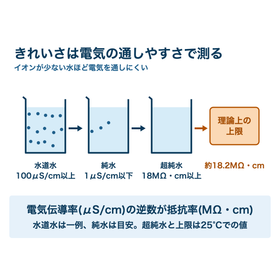
Deionized water, which has had ions dissolved in water removed. This explains the differences between pure water, ultrapure water, and soft water, as well as the mechanism for measuring cleanliness based on electrical conductivity.
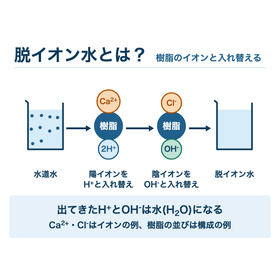
Deionized water is water that has had its dissolved ions removed through ion exchange resin. It is also referred to as ion-exchanged water. The process of removing ions is also described as "de-salting." Regardless of the terminology, the goal is to "reduce the ions dissolved in water."
■ What is dissolved in tap water?
Even drinkable tap water contains small amounts of ions such as calcium. While this is not a problem for drinking, these ions can cause issues as impurities in precise analyses or cleaning processes. In boilers, they can also lead to scaling.
■ How is it different from pure water?
Pure water is water that has had extremely low levels of impurities. It is produced through methods such as distillation, ion exchange, or RO membranes, either individually or in combination. Deionized water can be understood as water produced specifically through ion exchange.
■ Imagine erasing ions from a list
Consider tap water as a list of various ions. Ion exchange is the process of replacing those ions with different ions held by the resin, erasing one name at a time. The fewer names left, the cleaner the water becomes. Please feel free to consult with us first.